Edge-Cloud Reinforcement Learning for HVAC Control Across Vietnamese Climate Zones
Transferable HVAC control research with HOT building archetypes and Vietnam weather contexts
Research and reproducibility package for transferable HVAC control in Vietnamese climate zones. The project compares static, ASHRAE-style, cloud-only, edge-only, and edge-cloud adaptive controllers using HOT building archetypes, EnergyPlus-oriented simulation artifacts, transfer metrics, deployment scores, comfort violations, energy consumption, and latency analysis.
Timeline
2026
Type
Research
Status
completed
My work
- •Prepared the reproducible experiment structure, summary metrics, and manuscript figures
- •Packaged result tables, trained policy artifacts, cloud run notes, and the final report workflow
Outcome / Impact
- •Built reproducible experiment and manuscript artifacts for transferable HVAC control across Vietnamese building/weather contexts
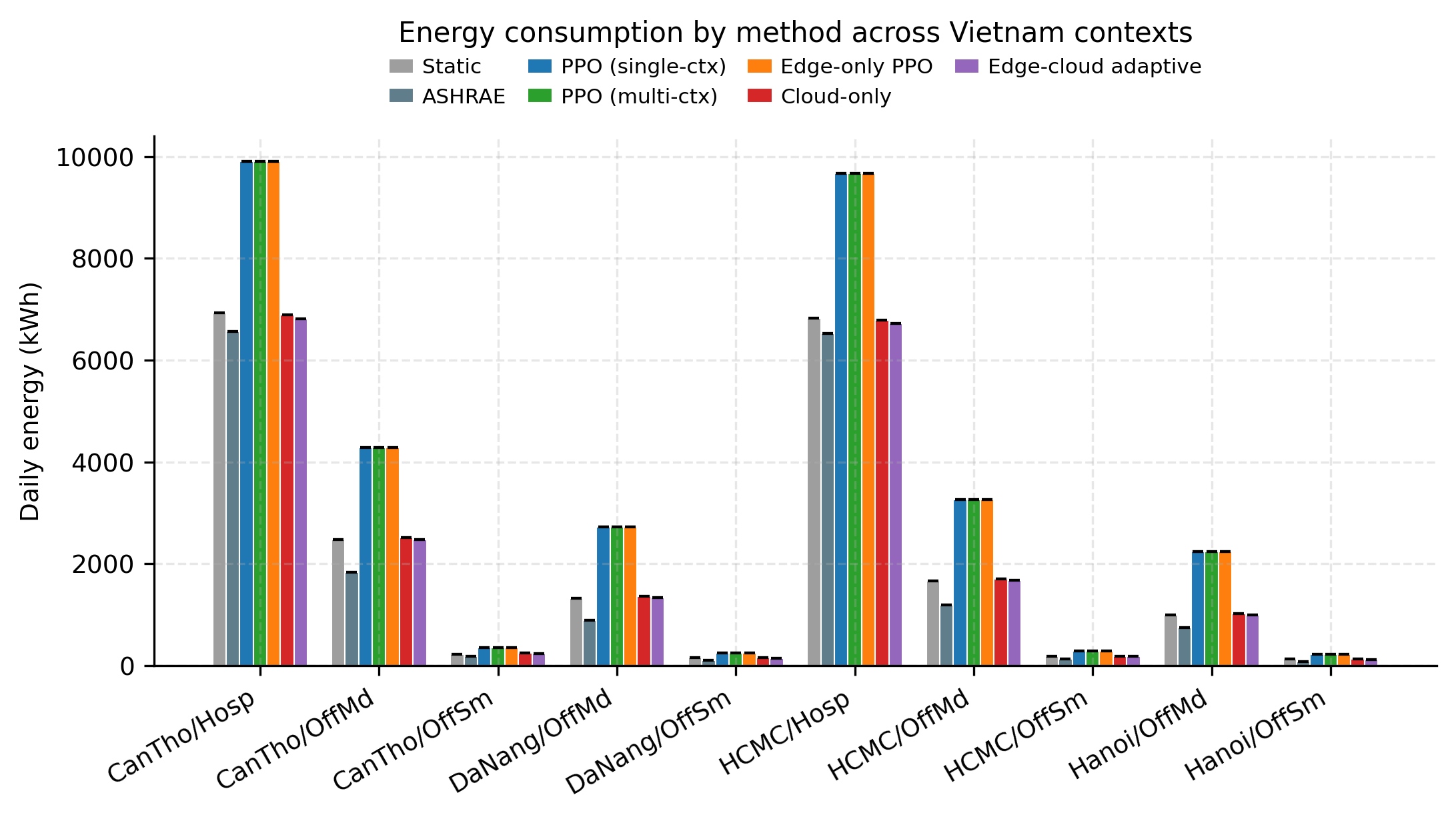
- •Compared controller families using energy, comfort violation rate, temperature deviation, action instability, deployment score, and transfer regret metrics
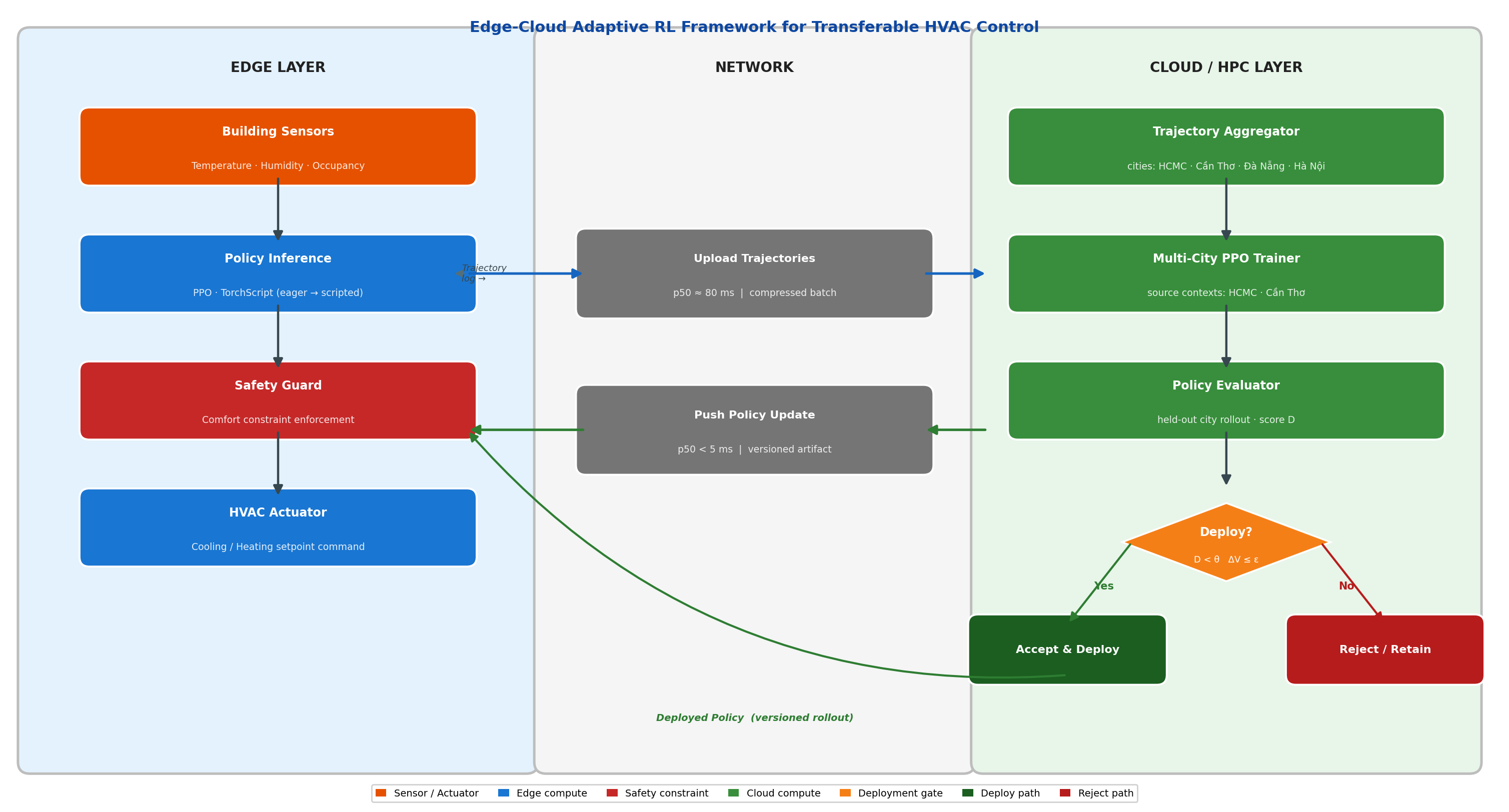
- •Generated publication figures for system architecture, Vietnam map contexts, policy update flow, energy comparison, comfort behavior, transfer efficiency, and latency distribution
- •Packaged cloud execution guides, summary CSVs, trained policy artifacts, manuscript source, and final PDF report
Tech / Skills
Project Media
Demo video and visual walkthrough for this project.
Project Screenshots
Case Study
1) Context / Problem
HVAC control in hot-humid climates is a multi-objective problem: energy savings, comfort protection, deployment latency, and transferability across building contexts all matter. Vietnamese climate zones add practical constraints around weather variability and retrofit readiness.
2) Your Role
I prepared the research code, reproducibility structure, result summaries, manuscript figures, and reporting workflow for evaluating edge-cloud HVAC control methods.
3) Approach
Organized experiments around HOT archetypes, Vietnam weather contexts, summary metrics, and controller comparisons. The evaluation pipeline aggregates control summaries, transfer metrics, latency distributions, and deployment-score views into manuscript-ready figures and tables.
4) Result / Impact
Delivered a complete research package with code, cloud run documentation, aggregated CSVs, trained policy artifacts, LaTeX manuscript source, and a compiled report. The final analysis made the trade-off between energy, comfort, transfer regret, and deployment latency explicit.
5) Learnings
For RL in building control, the policy score alone is not enough. Transfer regret, comfort safety, action stability, and deployment constraints need to be part of the same evaluation frame.
6) Links
See links above.